Posted: March 15th, 2018 | Author: Nathan | Filed under: modular synthesis, music, synthesis
“I just bought [FOO]; what other modules should I buy to go with it?”
Ahh, the cliché question that causes cringes worldwide in the modular synthesis world. But let’s not disparage those who are just learning. We were all there once, right? I sure was. Heck, I still am.
But what bothers me about this question is that it is absolutely context-free.
If you said that you had a saw, and you wanted to know what wood would pair well with that saw, I’d best the most common question you’d get (besides a quizzical look) is, “Well, that depends. What are you building?” Asking what tools or materials to get without knowing what the end goal is feels completely backwards.
Let’s say someone bought a smart, complex envelope generator. Great, such things are always needed in modular synthesis. But then someone asks what to get next, be it an oscillator, a sequencer, a filter, or an effect. Well…are you a harsh noise artist? An ambient performer? A techno producer? A sound designer for film? A guitarist trying to use modular for effects? A trumpet player looking for procedural beats to play on top of? A sound installation artist?
Those answers don’t just matter. They’re ALL that matters.
This, of course, applies to microphones for field recordists, traditional synths for other musicians, or string gauges for guitarists. My advice is always, and will ever be, this:
Listen to your own music with what you have, and it should tell you what you need.
- Does it sound thin, or do you feel like you want more layers? Oscillators and sequencers and VCAs and filters and effects…or some/none of them. Depends on what you want to hear in the mix, and what you’re trying to say.
- Does it feel repetitive or too simple? Modulators and VCAs, possibly some randommess.
- Does the sound seem too dry or stale? Modulators, filters, and effects.
- Does the sound want more high-level structural changes? Modulators that can transpose, VC mixers for either/both audio and control voltage. LFOs and envelope generators that have very long cycles are great for that, too.
- Did you get a few modules but you feel like you need more control? Attentuators, modulators, VCAs.
- Do you want the machine to generate audio on its own? Envelope generators with end-of-rise/fall trigger outputs, maybe a quantizer, LFOs, comparators, random sources.
This is a radical oversimplification, but no single person’s advice is going to tell you the right next module(s) for you. Your system, studio, or mic locker will be far more effective (musically, and in terms of cost) if you know what you’re trying to achieve first.
| No Comments »
Posted: October 2nd, 2016 | Author: Nathan | Filed under: music, synthesis

Beelzebuzz on the bus!
I spend between two and three hours a day on a bus. I’m not proud. But one learns to adapt. And in that adaptation, surprising discoveries come about.
In my case, I rediscovered a love for an often-maligned audio application, and learned a ton about modular synthesis while riding over the Golden Gate Bridge ten times a week…one that ultimately led me to invest in modular synthesis hardware, which was the subject of my previous post. But if you’re curious about modular synthesis, for real, doing it in software first can be pretty darned smart. And cost-effective.
When I revised my studio hardware late last year, I decided that a MacBook Air would be a part of the mix. What a revelation that’s proved to be! So small, so light, and – even in its dinkiest incarnation – just as powerful as the older “proper” laptop it replaced. But as a guy who loves field recording, found sounds, and sound design, how could I use this tool on the bus creatively? Surely there must be a good way for me to spend time on my commute learning something. And I learn best through doing.
I explored what skills I could build on my bus ride to and from work, and decided two options existed: Learn more about music composition and theory, and learn synthesis at a seriously deep level. Being that the bus is a horrible listening environment, and I won’t ever be That Guy that brings a keyboard controller on his commute, I opted for the latter.
I forgot that I had a working, real license of Propellerheads Reason, sitting uninstalled. So I installed it on the MacBook Air and decided to set a few goals for myself.
- No playing through the MIDI keyboard, and no MIDI notes entered on a piano roll. All sequenced as if on a modular synth.
- No presets, ever. Clear all the settings (or find the most raw one) and always start with that.
- Don’t stop until you can create at least the standard drum sounds, bass, leads, and pads using subtractive synthesis.
- Don’t stop with just simple pure tones. Modulate everything so that it lives, breathes, and has some motion or unpredictability to it, even if it’s subtle.
I’ve become a solid user of analog synths over the years, but never directly set myself to learning them so deeply. Suddenly the “pre-wired” nature of Reason’s Subtractor synth became stifling, so I started using synths just for their filters or LFOs and patching them with other synths. Then I got a number of super-raw, purely modular Reason Rack Extensions from Ochen K. And then I started to get more parametric, procedural, and probabilistic sequencing Rack Extensions. My wallet was happy that I wasn’t buying modular synth hardware…but, of course, that came to a screeching halt.
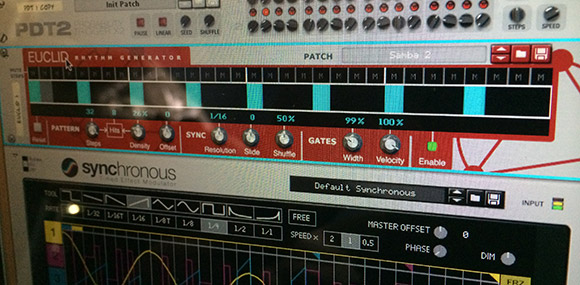
Probability-driven drums, Euclidian synths, and waveform-controlled gates and velocities. Oh my.
Things got mathy quick. I have hours’ worth of glitching, burbling, super-weird virtual analog sounds and textures. If anyone ever needs alien telemetry sound effects, I’ve got a lifetime’s worth. (Pro tip: Throwing these aggressive textures into iZotope Iris is a whole other way to waste an entire day in sound heaven.)
But glitch, noise, and analog freakouts, my friends, are really relatively easy to do (and like many things, doing them extremely well is very labor intensive). Making melodic, rhythmic things in a modular way that don’t loop, per se, but yet still hold together over time…that’s even trickier. Focusing on that process really filled in my gaps in my synthesis knowledge. My main workflow now is sketching on the bus, tone sculpting once I’m in a better listening environment, and then rendering out stems of performances or patches for further work in a more traditional DAW. There, I often find that using a subtle tape saturation effect and physically-modeled compressor plugins can help bring in some of those overtones that analog gear is so renowned for.
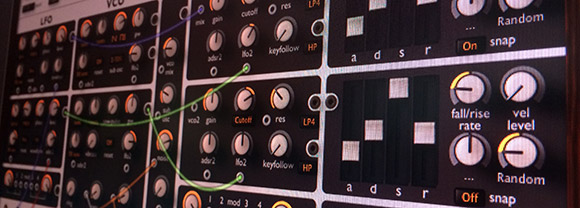
Surprisingly few pro applications and virtual instruments offer the patching options of Reason and its modules. Here, U-He’s ACE semi-modular virtual synth bucks that trend. Madrona Labs’ Aalto is also superb.
And yet there, back in my powerful traditional DAW, I find myself missing all those little CV ports in Reason, allowing me to modulate anything with anything. Why can’t I take the pitch CV of a synth plugin and use it to modify a delay time parameter? Or use a buffer override or stutter plugin to retrigger an envelope generator? You can simulate these things with MIDI processors but it’s just not the same.
Suddenly my little MacBook Air feels like the world’s smallest, lightest, and maybe cheapest modular synth around. (Note that I didn’t say “best.”) If any readers are considering building a modular synthesizer, you could do a lot worse than learning your way around modular synthesis with Reason…since it costs the less than many single Eurorack synth modules.
Today’s sound combines edits of live programming and performance with machine-driven sequences, all centered around things made on my commute. What parts of your day could be more effectively used for focusing on creative pursuits?
[soundcloud url=”https://api.soundcloud.com/tracks/214330829″ params=”color=ff5500&auto_play=false&hide_related=false&show_comments=true&show_user=true&show_reposts=false” width=”100%” height=”166″ iframe=”true” /]
| No Comments »
Posted: May 31st, 2016 | Author: Nathan | Filed under: music, news, synthesis
DRIFTER – Album Teaser from Noise Jockey on Vimeo.
The second in a trilogy of albums, Nathan Moody’s Drifter LP is now available as a digital download (Bandcamp, iTunes, and Amazon) and a limited edition of 100 signed and numbered compact discs.
Drifter is a more ethereal journey than his last album, Dissolver, with fewer beats but Moody’s signature balance between sound design and music. This makes it even more cinematic in mood. Its compositions are looser, often based on improvisations with field recordings, synthesizers, and guitar.
Nathan Moody – “Earthly Disappointments” music film, from the Drifter LP.
The upcoming Deceiver album will complete Moody’s trilogy later this year.
Comments from early listeners include:
“I was pleasantly unsettled by Drifter”
“Beautiful textures and tones throughoutâ€
“It comes across as more confident, forward and assured”
“It’s simply beautiful.”
For more on the release of the Deceiver album this fall, stay tuned to music.noisejockey.net, noisejockey on Twitter, and noisejockey on Soundcloud.
| No Comments »
Posted: April 19th, 2016 | Author: Nathan | Filed under: music, news, sound design, synthesis
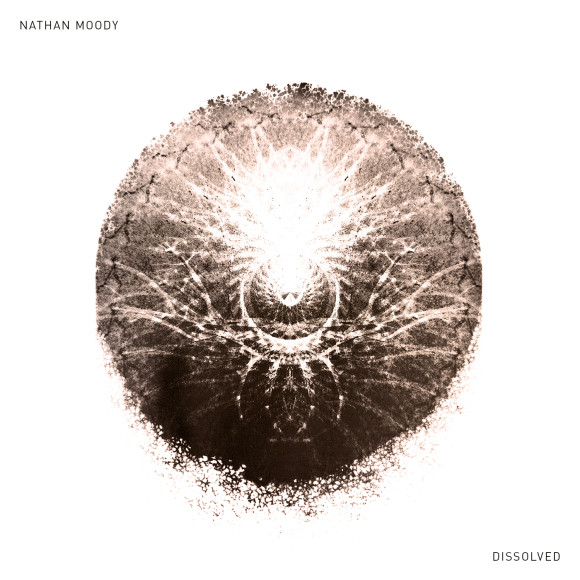
Following 2015’s full-length album, Dissolver, I’m happy to announce the release of Dissolved, an EP with remixes by musicians from around the world. The US is represented by A Box in the Sea (WA), The Sight Below (NY), and r beny (CA); other contributors include The Heartwood Institute (aka Jonathan Sharp, UK), Hainbach (DE), and Fake Empire (NZ). The remixers’ techniques were as varied as their locations, from DAW-based arrangements to use of vintage hardware to recordings using dictaphones. The pieces exhibit a similar range of moods and styles as the original Dissolver LP, from lilting to tense, ambient to percussive, experimental to melodic.
Mastered by Rafael Anton Irisarri at Black Knoll Studio, Dissolved is available now via Bandcamp as a pay-what-you-like release.
| No Comments »
Posted: October 29th, 2015 | Author: Nathan | Filed under: music, news
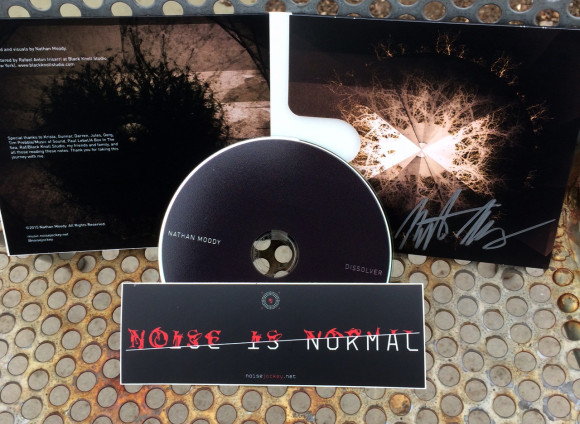
Just a quick announcement that my latest album, Dissolver, is now available as a limited-edition CD, hand-signed, hand-numbered, with an exclusive limited edition sticker. This run of 100 won’t last long, and when it’s gone, that’s it.
Nab you one today, son! More details here.
| No Comments »
Posted: October 25th, 2015 | Author: Nathan | Filed under: field recording
I found myself at Jack London Square in Oakland during San Francisco Fleet Week. The majestic Lady Washington was in port, so I skulked around with my Sony PCM-D50 field recorder (I was there for other purposes, so I wasn’t toting around my full field recording kit).
It was a foggy morning and the air was still, and the ship wasn’t really making any sound. Its dock, though, sure was. It wound up being one of my favorite sounds in some time, between the metal strains, the rubbing of rubber, and the lapping of water.
[soundcloud url=”https://api.soundcloud.com/tracks/228158520″ params=”color=ff5500&auto_play=false&hide_related=false&show_comments=true&show_user=true&show_reposts=false” width=”100%” height=”166″ iframe=”true” /]
Even more interesting was the jazz quartet that set up mid-deck on the Lady Washington around lunchtime. I don’t know what they were playing, but here it is, regardless, recorded about 60′ away. Loads of people to the right of the stereo field, nothing but open bay to the left.
[soundcloud url=”https://api.soundcloud.com/tracks/228159052″ params=”color=ff5500&auto_play=false&hide_related=false&show_comments=true&show_user=true&show_reposts=false” width=”100%” height=”166″ iframe=”true” /]
| No Comments »
Posted: October 12th, 2015 | Author: Nathan | Filed under: field recording

MY TAX DOLLARS…!!!!
When I was a kid, I loved jets. Like most boys, I seemed to love vehicles of all sorts. That all waned as I got older, but fast fighter jets are pretty impressive machine…even if the US Navy’s Blue Angels make my blood boil with their noise, and when I think that my tax dollars pay for all that jet fuel in their F/A-18 Hornets.
Nevertheless, as an audio recordist, jet fly-bys aren’t that easy to get on cue. So, every year, I try to record the Blue Angels over San Francisco during Fleet Week. I always say I’ll go somewhere and record them, but life gets in the way on the weekends. But Thursday and Friday beforehand, they do practice runs over the city.
I planned to go onto the roof of my workplace, but a bunch of tech hipsters got there first: Too much talking and reaction sounds. So I just stuck my Sony PCM-D50 out the window, in a small channel between skyscrapers.
When these things scream by, I was measuring between 40dB and 50dB over the background noise level…which, in an urban area is already between 40 and 70dBA. The PCM-D50 has pretty bad limiting – it actually is always recording at two different levels, and fades between the two, so it’s not even a real limiter. So you need to set your levels very carefully. I did a test on Thursday to get just two fly-bys on Friday that were relatively clean.
I liked how the sounds were rendered. The reverb off the tall buildings was nice, even though the background noise masked some of the jets’ approach. But in a city of 760,000 people, you take what you can get…
[soundcloud url=”https://api.soundcloud.com/tracks/228156555″ params=”color=ff5500&auto_play=false&hide_related=false&show_comments=true&show_user=true&show_reposts=false” width=”100%” height=”166″ iframe=”true” /]
| No Comments »
Posted: October 7th, 2015 | Author: Nathan | Filed under: field recording, gear, news
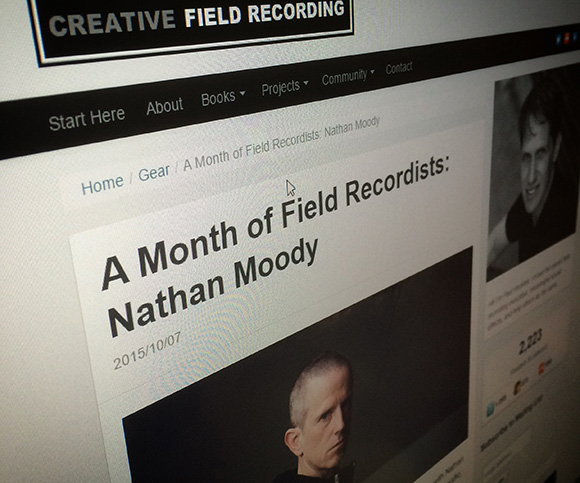
Paul Virostek of Creative Field Recording, focuses more on approach and technique than equipment, which I think is entirely appropriate. It’s all too easy to get caught in the vortex of gear over doing creative and innovative things with it.
However, it’s always interesting to know what people do use, and why, and what informed their decisions in doing so. To that end, Paul is in the midst of “A Month of Field Recording,†and yours truly was the latest to be profiled, among such field recordist luminaries as Frank Bry, Watson Wu, and many others.
I’m deeply humbled to have been asked to contribute to this series, and thank Paul for the opportunity. What’s more, I also need to thank the online recordist and sound design community, without whom I’d basically know nothing.  More than half of those being profiled by Paul this month are people who have exhibited nothing but excitement and patience in fielding my questions to them about gear, practice, and theory.
| No Comments »
Posted: September 14th, 2015 | Author: Nathan | Filed under: music, news, sound design, synthesis
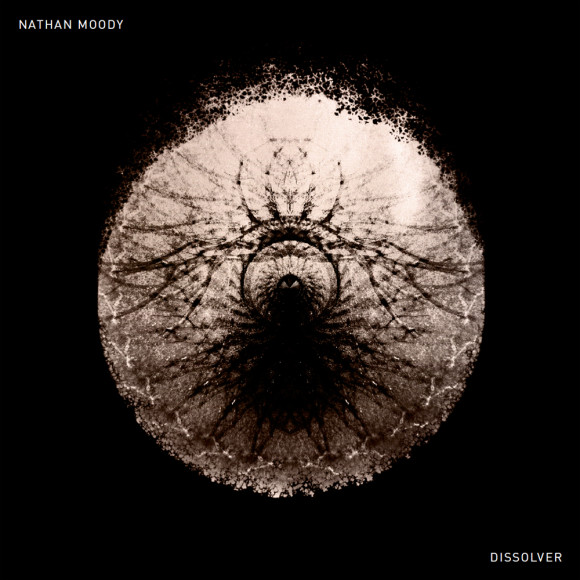
My first full-length album is available today.
I’m thrilled to announce that the first album I’ve released under my own name, Dissolver, has been released. It is available now as a digital download on Bandcamp (with PDF booklet with additional artwork and liner notes, exclusively available on Bandcamp). You can also buy it as a digital album on iTunes, Amazon, and Google Play.
I produced all the music and artwork, and it was mastered by Rafael Anton Irisarri at Black Knoll Studio. You can read more about this release at this blog’s sister site, music.noisejockey.net.
Work is already afoot on another releases, so stay tuned here, Bandcamp, Twitter, Soundcloud, and Instagram. Until then, please enjoy the noise, and reach out with what you think of Dissolver.
| No Comments »
Posted: August 31st, 2015 | Author: Nathan | Filed under: music, news
Today, I’ve got two exciting announcements to share!
First, there is a new subdomain and site that tracks my musical output: music.noisejockey.net. This blog will remain focused on sound design, audio technique, and field recording, whether the final output or usage is musical or not.
Second, I’m releasing my first full-length LP, titled Dissolver, on September 14. It will be available as a digital download on Bandcamp, Amazon, iTunes, and Google Play. Read the full announcement, and listen to a four-minute album teaser.
Watch this space and my Twitter feed for more!
| No Comments »