California’s winter of 2022-2023 was one of the stormiest and wettest on record. Near-constant atmospheric rivers and wind events for four months generally made going outside A Bad Idea.
Not great news for those of us that like to do field recording. But, as often happens, constraints do wonders for spurring inspiration.
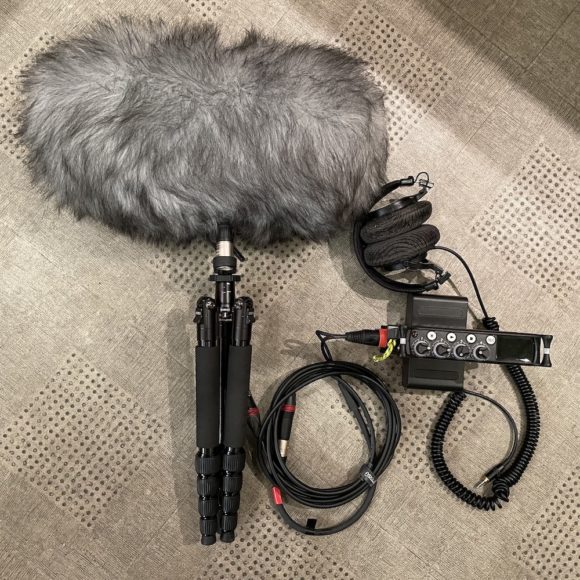
During one especially torrential downpour, I was thinking about how loud it was on the roof…but we have an attic crawlspace between us and the roof, so how loud must it be up there? I had just created a small, compact ORTF recording setup (Sound Devices MixPre 6ii, two Schoeps MK4/CMC1U microphones, Rycote blimp), and its size allowed me to put the rig in the crawlspace, and let it record all through the night while I slept.
The results were deliciously unusual: The rain was close-miked, but it was still clearly an interior perspective. Its volume drowned out whatever neighborhood noises there might have been. The open-faced insulation batting in the crawlspace created a space with almost no reverb. The result took reverb in post very well, providing flexibly usable interior rain and wind tones.
In fact, I now have a similar setup using a pair of Line Audio CM3 microphones ready to be put up into my attic at a moment’s notice; I keep it up there most of the winter, and just plug a 5-pin XLR cable into it, running to the recorder, whenever there’s a blustery day or some rain. This “attic rig” delivers gold pretty regularly…assuming I can record at night. There’s too much noise of general house habitation during the daytime hours. The CM3’s are no Schoeps, but they are a whole lot more expendable due to their lower price, in case of a leak, particulate matter, or rodents.
Here’s a composite of heavy winds, light rain and some wind, and heavy rain from a few different recording sessions.
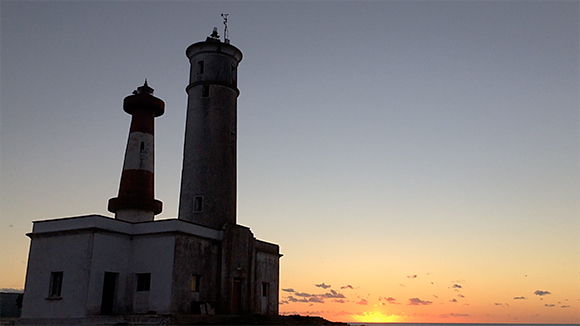
We had two days of 15-25 knot winds, and as you might imagine, a lighthouse is a roughshod place. The winds were howling through the old windows and making amazing sounds.
Only one problem: I had a small sea kayak with no room to even pack a handheld field recorder. As I’ve said many times before, the best field recorder is the one you have with you, and this case, my only option was my iPhone. In glorious, shimmering mono.
Today’s sound are of these howling winds, recorded with the Voice Memos app on iOS. I’m not about to make a habit of using my iPhone as a field recorder, even with aftermarket microphones, but hopefully this goes to show that sometimes you do the best with what you have. Especially if the sounds and location are literally once-in-a-lifetime events.
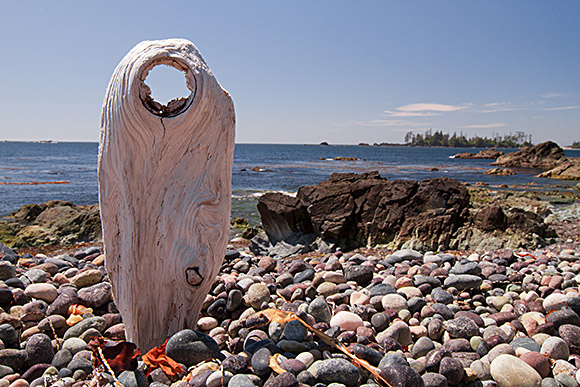
The view west to the Pacific Ocean from Catala Island, British Colombia, Canada.
During my 2013 kayak-camping expedition on the west coast of Vancouver Island, I spent a day by myself photographing and field recording Catala Island. You know you’re in a remote area when you refer to Vancouver Island as “the mainland.”
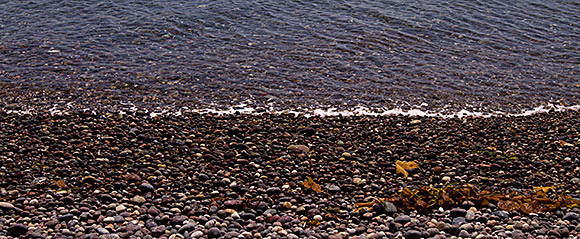
I found myself on a beach away from the direct Pacific swell, with a nice mix of pebbles and cobbles that made a wonderful rainstick-like tone when the gentle waves receded. (Of course, I’ve posted on recording waves before.)
Cobble cobble cobble.
But as isolated as I was, man made sounds still managed to intrude. A lonely acoustic buoy in the distance bleated like a seasick cow on every incoming swell. You may be able to hear this in the background of this recording, faintly, although an aggressive 130Hz high pass filter helped remove the worst of it. Luckily this also removed the distant roar of the sea, actually helping to focus the sound on the small waves that really didn’t have much low-end to them at all.
Many dozens of miles from any road, on an island off another island off the main continent, the sounds of man still pervade. Or perhaps invade.
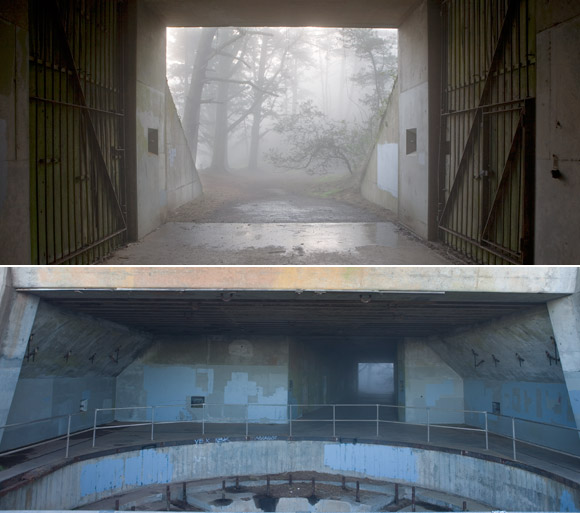
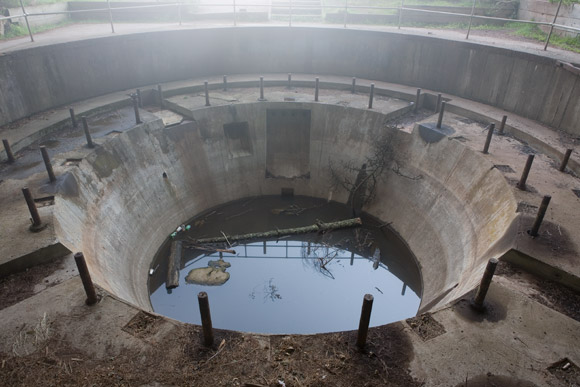
“Construction 129,” a never-completed gun emplacement overlooking the entrance of the Golden Gate, Fort Cronkhite, Marin Headlands, California.
When a winter storm was forecast for the San Francisco Bay Area, I decided to head to the Marin Headlands and try my luck recording bad weather in the abandoned gun emplacements and military fortifications of Fort Cronkhite. I had previously found some great metal sounds at Fort Baker, also in the Headlands, and I was also inspired by Tim Prebble’s high-wind-sub-bass-generator post.
Unfortunately for me, the storm track was slower than predicted, and I wasn’t able to record in peak wind, although some moderate rain started to fall. Such things happen, even with the best of intentions. So, what do you do when your primary plan doesn’t pan out? You reset your expectations and record what you can. I mean, c’mon, I’m in these amazingly evocative ruins! Surely there’s something that’s audibly interesting!
So, I decided to record rain in the tunnels. A recent re-viewing of Ridley Scott’s Prometheus reminded me that tunnels and caverns in films often feature water drops that are drenched in heavy reverb. I pressed the “record” button in several settings and closed my eyes: Was I in the bowels of an ancient spacecraft? The Mines of Moria? The hull of a leaky, empty freighter?
The gun emplacement at Construction 129. No weapon was ever installed.
Occasional wind blasts forced me to enable a high pass filter at 120Hz to try to remove some of the ambient rumble that didn’t help the recording. In addition, there are no fewer than three foghorns in the Marin Headlands, so I had to make an edit every 50 seconds to eliminate the lonely bleat of the Point Bonita lighthouse horn.
There is always something worth recording. You just need to let your disappointment go, reset your expectations with some beginner’s mind, and just start rolling.
I was sick at home one fall day and I heard a European starling singing. Loudly. I didn’t see it outside of any doors or windows, all of which were shut anyway, and then realized that it was perched on my chimney, and therefore was singing right into my house.
All my high-end nature recording mics were in my closet; nothing was hooked up and my batteries might not have been charged. So, even with oodles of gear around, I just grabbed my handheld Sony PCM-D50 that was right on my desk, and started rolling.
Of course, the chimney did an equally good job funneling nearby road noise. Perhaps its narrow aperture did some pre-filtering on that background noise, as it was pretty easy to remove using iZotope RX. It also helped that the signal to noise ratio was very high, given the bird’s proximity relative to the ambient noise. (Tip: Ever use Strip Silence on birdsong? Try it. Super weird!)
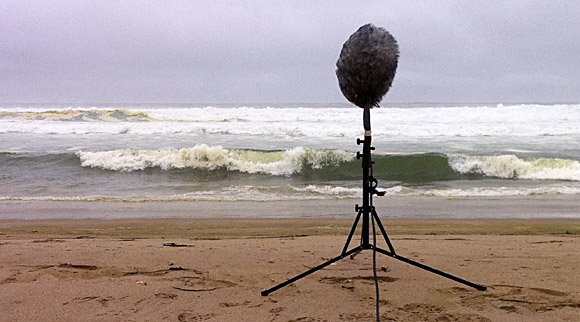
Look carefully: Deep impact zone, short period, wind parallel to the shoreline. Not a good day for recording single waves. So...what is?
It’s easy to get recordings of roaring surf – which can often just sound like constant white noise – but it can be tough to get relatively clean recordings of individual waves. I’ve found that picking a good day and place to record single wave hits are a combination of marine forecasts and location, and that the size of the waves really doesn’t matter.
Single-wave recording conditions are largely defined by a mix of swell, wind, and location.
Swell is due to the large movements of water over great difference; swell is not the same as waves, which are usually wind-driven. Swell is usually forecast based on buoys offshore, and is forecast days in advance. However, I find that 2-day swell forecasts are the most accurate. Swell is defined by wavelength and amplitude, just like audio: Wavelength is is measured in seconds (usually called period), and amplitude (usually called height) is based in feet or meters. Ideally, you want swell with long periods, because that means there’s a greater volume of water moving, but tall swell is also your friend, because that also influences breaking-wave heights at the shore. (Tip: Waves come in “sets” of big and small, between 3 and 8 waves each, depending on if there are multiple wavetrains that are in or out of sync. That means record for far longer than you’d otherwise think in order to get a good range of big vs. small waves over time.)
Getting back to the topic of wind, not all wind is bad (and we all know what wind does to field recordings: huge amounts of badness.) Offshore winds (those that come off of the shore – yes, that is totally confusing!) will might wave faces up longer than they’d be up otherwise, causing a moment of quiet before the wave breaks (or “closes out,” in surf parlance) and a potentially taller wave face. Wind coming onshore (onto the shore from the water) often smears the wave tops and can cause premature toppling…not to mention the fact that the wind will be blowing directly at your microphone capsules. (Tip: You can’t be at the shore without shorebirds, often noisy ones. Bird feeding activity, and therefore noise, may peak before an oncoming storm. Watch the forecast and choose clear weeks with low-pressure days, when it requires more energy to fly, when possible to reduce avian noise. Gulls are complete bastards in this regard!)
Finally, this brings us to location. Some of this is taste: Do you want to record breaking waves against sand, or against rock? Very different sounds will come out of each; bigger crashes will happen on rocks as opposed to sand. But beyond that, know a bit about your location. What direction is the swell and wind coming from, relative to where you’ll be facing? How does the land curve around, creating refraction waves? What is the slant of the land below the shoreline? This last one is especially critical, as the gentler the slope, the bigger the wave. The “impact zone” – where the waves actually break – can be deep or narrow, and a narrower impact zone will generate fewer audible breaking waves at once. Knowing if a beach has a “dumping break” is useful: It makes it terrible to launch from or surf near, but that also means the waves break right at the shoreline, which is far better for audio recording. Just watch out for your gear. (Not a tip, but trivia: Waves always break when the water depth is 1.3x to 1.5x the wave height, as the horizontal energy of the swell gets forced upwards to create breaking-wave heights near shore.)
Never turn your back to the sea. The sea is huge, powerful, indifferent, and above all, unpredictable. Rogue and “sneaker” waves are not legends or myths: They occur regularly, anywhere in the world. Don’t let a recording session end in tragedy.
A final note on technique: If you’re on a beach, angle the mic a bit more downwards than you’d think would be wise, and you’ll get nice sounds of the sand being pulled back as the breaking waves recede back into the ocean. Not always good to have in every recording, but this adds a lot more character. On a beach with fist-sized rocks, this can be especially cool!
I had a recent session at a sandy beach in the Point Reyes National Seashore that exemplified some of the better (but not quite perfect) conditions that I describe above. First, the wind was blowing at 20 knots…but from the opposite direction of the beach I was on, which was backed by hills. That meant delayed wave breaks and being protected from the wind. There was a southerly swell that came right into the dumping-break beach (I can tell the period is averaging 14 seconds by looking at the waveforms of the audio!), so it was all breaking swell and no wind-driven waves. It was a low-pressure day with a long-term clear forecast, and it wasn’t winter, when the masses of migratory birds come through Northern California. Only one swallow’s call made it into the recording.
The recordings aren’t all that dramatic when you consider the breaking waves were only 3-4′ high. But listening to this loud on headphones, eyes closed, I find that the sense of scale is quite exaggerated without an accompanying visual reference…a little Waves LoAir or layering some low-frequency booms can definitely can tip it into cinematically-big breaker territory if desired. However, even in a 90-second clip, there are only three really distinct wave “claps” as the bigger waves close out at the beach.
Thus quoth the raven, "Press record, idiot!" (This picture was taken years ago in Oakland, CA, not where today's sound was recorded.)
[One in a series of posts from my spring 2011 trip to the southern California desert.]
I love ravens. Not because I’m all Mr. Gothy McLordbyron, but because they’re big, majestic, smart as hell, and have gravelly voices. Like crows, but drunker. They’re the Tom Waits of the bird world.
Ravens aren’t exactly rare, and perhaps because of this, they’re hard to record in the wild. They can be anywhere: Urban areas, tops of trees, windswept hills…but by the time I show up with a recorder, they’re either deciding to be quiet or are surrounded by traffic noise, intense winds, other birds, or even people. I’ve had the darnedest time capturing one cleanly.
Thankfully, the ravens of Joshua Tree National Park are pretty fearless…well, they’re also always looking for snacks, and have learned that people can be a good source for tasty (dropped) morsels. I’ve noticed that they often travel in pairs or groups of less than four to six, and one day we were followed by a pair of ravens as we wandered the desert trails. The vocalizations aren’t anything super-special, but they’re (for once) pretty clean, articulate, and detailed. Just what I was hoping for!
This raven was talking to his companion quietly as they spread out looking for snacks. He landed about twenty feet from me and I recorded him as he was hopping around. I like the little lilt he added at the end!
[One in a series of posts from my spring 2011 trip to the southern California desert.]
Anza Borrego Desert State Park is the second largest state park in the lower 48 United States. It’s dry, as its name implies, but it’s very seismically active and has many natural hot springs and oases scattered throughout the park, so water is less scarce than you’d think.
Even so, it shocked me almost beyond belief how filled some of these hot seeps were with frogs, and how loud they got at night. Sadly, I didn’t get any pictures of these tiny thumb-sized frogs, puffing out their chins to impress their ladyfriends, but I watched them for an hour with my headlamp while I recorded them from several perspectives. (Tip: Get a headlamp with a red LED or filter. This goes a long way in preserving your night vision while still illuminating nearby things like field recorder controls, and tends to spook animals less.)
Here is one long take from this session. It starts with distant frogs, one slow croaker nearby, and then gets really hopping (ugh, sorry, I had to do it) around 1 minute in. Then, after two and a half minutes, it dies down as quickly as it started.
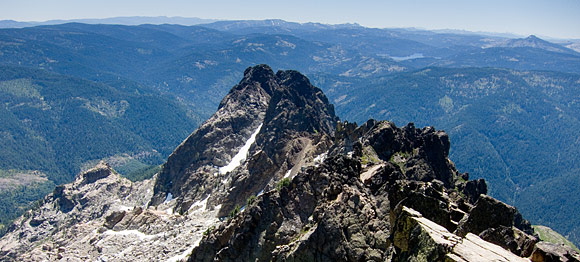
Sierra Buttes, California: Less than 9,000' high, but the tallest thing around...with active insect soundscapes!
The thing that strikes me the most about recording at high altitude is the quiet. Sounds that get masked by wind, rustling leaves of trees, traffic, and other sources become extremely articulate. Unless there are birds nearby, this usually means that insects are what comes to the ears most clearly.
Atop a California mountain on a sunny summer day, I came upon a patch of blooming buckwheat that was being visited by bees and other insects. The trees were pretty far away, but cicadas were singing loudly, and the wind was pretty still. I set down my recorder and walked away for about 20 minutes to bag a nearby peak.
The killer moment in this otherwise quite ambient snippet is right near the end, when a huge, fat something buzzed right past the mics. I’m assuming it’s a type of bee, but with such a deep, rumbling sound, it sounds like a cartoon or a parody of an insect sound, like something out of A Bug’s Life, as opposed to a real creature. Since I walked away during the recording, I’ll never know!
[soundcloud url=”http://api.soundcloud.com/tracks/5760409″ params=”show_comments=true&auto_play=false&color=ee0000″ width=”100%” height=”81″ ] [Sony PCM-D50 field recorder]
I’m thrilled to announce the existence of Sonic Terrain, the world’s first portal dedicated entirely to field recording in all its myriad forms. I’m a co-founder and editor alongside Miguel Isaza (of Designing Sound), and we’ve enlisted the help of Colin Hart and Michael Raphael, surely with more editors and contributors to come. We all think this will be a great place for those who record outside of the studio environment to share and learn from one another. From music to science, from entertainment to fine art, we’ll be covering it all, through both aggregated and wholly original content.
Sonic Terrain has just launched today, but there’s a lot more in store. Oh, yes, do we have plans. Please visit, comment, and drop me a line at nathan [_at_] sonic-terrain [_dot_] net if you’ve got something you’d like to contribute. We’ll see you there!