Posted: October 27th, 2014 | Author: Nathan | Filed under: music, synthesis

Today’s track is comprised of several ominous improvisations with analog synths: Korg Volca Beats, Korg Volca Bass, Waldorf Pulse +, and Grendel Drone Commander. A couple of virtual analog software synths were also used to round things out in the edit.
Nice to get back into the pure subtractive synthesis world for a whole, in terms of sound design. I need to grow more hands if I’m to tweak this many knobs at once…
[soundcloud url=”https://api.soundcloud.com/tracks/173187112″ params=”color=ff5500&auto_play=false&hide_related=false&show_comments=true&show_user=true&show_reposts=false” width=”100%” height=”166″ iframe=”true” /]
Tags: analogue, audio equipment, music, music 2014 | No Comments »
Posted: October 1st, 2014 | Author: Nathan | Filed under: gear, music, sound design, synthesis
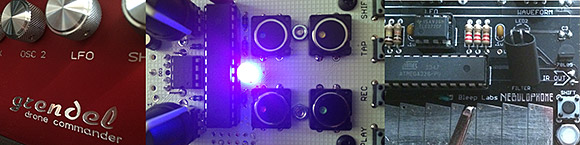
Hand-built for drone-y aggression.
I love handmade soundmaking devices, but outside of my beloved Grendel Drone Commander, a lot of the weird noise boxes and effects I have are, well, noisy. They tend to be aggressive, loud, and blippy. Some accept MIDI, some accept CV, some accept no sync signal at all.
One evening I wondered if I could coax them into some semblance of ambient drones, to loosen myself up and not record to a fixed tempo, and to not get too “precious” with editing in post. Somehow the angry nature of these devices just seems to bleed through anyway. Or is that my angry nature?
So, the result of this cathartic experiment was “angry ambient.” Or, angrient.
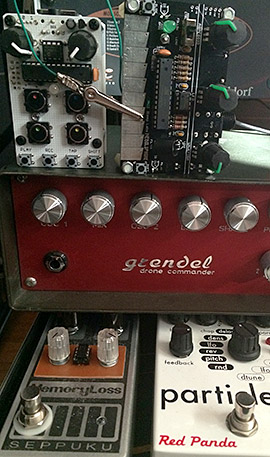
This track features the following:
- All takes recorded live into Logic Pro X: No sync to anything, no MIDI, no CV.
- One track of a Bleep Labs Nebulophone, with its alligator clip clamped onto a key for a sustained drone, recorded through a Red Panda Particle pedal set to Reverse, both tweaked live. The dry and effected track were tracked simultaneously.
- Another droned Nebulophone track went through the Particle set to Delay, and then through a Seppuku Memory Loss pedal, with its clean microchip inserted, all three tweaked live. The dry and effected track were tracked simultaneously.
- One track of the RareWaves Grendel Drone Commander, recorded 100% dry. That thing needs no love, especially when its bandpass filters gets overdriven at low frequencies. Yummy.
- One track of the Bleep Labs Bleep Drum, played live in Noise mode, but then run through Glitchmachines’ Fracture plugin first, and the Michael Norris Spectral Partial Glide filter. That’s what generates the bright, granulated shimmers. These are the only digital effects plugins on any channel.
- Volume automation was done in one pass, “live.”
- The whole thing is run through U-He’s Satin tape emulator plugin for some additional harmonics and mid-high sweetening.
It is what it is.
[soundcloud url=”https://api.soundcloud.com/tracks/168600426″ params=”color=ff5500&auto_play=false&hide_related=false&show_comments=true&show_user=true&show_reposts=false” width=”100%” height=”166″ iframe=”true” /]
Tags: audio equipment, drone, experimental, music 2014, sound design | No Comments »
Posted: April 2nd, 2014 | Author: Nathan | Filed under: field recording, gear, sound design
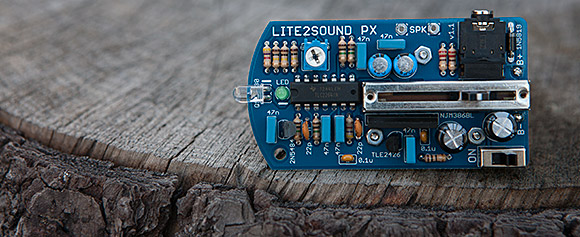
Rare Waves’ Lite2Sound PX, by Eric Archer: A photonic microphone!
I’ve previously written about the heavily-built, wickedly cool Grendel Drone Commander synth from Eric Archer. I check his site, Rare Waves, from time to time for new handmade electronic toys, and I was really intrigued by his newer Lite2Sound PX unit. This small device, in Eric’s words, “extracts audio from ambient light.” It’s a photodiode amplifier. Or a photosensitive microphone. Point it at light, it makes sound. It runs off a 9-volt battery, has a volume control, and a headphone jack. Simple, exciting, and a whole new world of sonic insanity. You can buy them as kits or, as I did, fully assembled.
Sounds pretty straightforward. If you just point it at bright, broad light sources, it’s kind of disappointing. It’s when you start listening to artificial lights in otherwise dim environments that some serious magic starts to happen. My experiments were conducted in and around high tech computer equipment, running an 1/8″ mini jack from the headphone output into my Sony PCM -D50 recorder.
Lights inside of PCs, modulated by fans…and further modulated by speaker grills as I passed the Lite2Sound from side to side. Ethernet network activity lights. Server disk access indicator lights. A close up of the power button of an XBox 360 while booting up. Pulsing lights of devices in standby mode. Halogen lamps behind spinning desk fans.
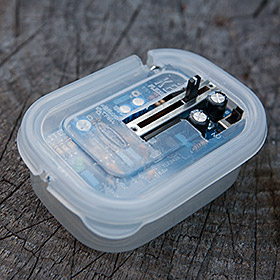
Lightly armored for future fieldwork!
The resulting sounds were astounding in their range: Static, glitches, distorted synth pads, pure sinewave tones, sawtooth-like tones, and much more. You can’t control it, really. It’s a tool of discovery, and its very nature encourages constant experimentation. It was so small and so perfectly complemented a handheld field recorder, I just wanted to take it everywhere and point it at everything! It imparted the same joy as when you start recording with contact microphones, or hydrophones: A new way to listen to the world around you. The more I used the Lite2Sound, I put it in a small plastic container (hacked with an XActo knife for access to controls and the headphone jack) in order to keep the components better protected.
Lite2Sound is a pretty narrowly-focused device and how useful it is to you depends on your taste for the unpredictable. Me, I adore this thing. Hell, I bought two (for future stereo photo-phonic insanity). It encourages constant experimentation, weighs nothing, and I can see using its output in both sound design and musical contexts. Eric Archer nails it again with an odd concept and a rock-solid, focused execution that results in a toy that just begs to be played with.
[soundcloud url=”https://api.soundcloud.com/tracks/139812053″ params=”color=ff5500&auto_play=false&hide_related=false&show_artwork=false” width=”100%” height=”166″ iframe=”true” /]
Tags: audio equipment, digital audio, field recording, sound design, sound effects | 3 Comments »
Posted: December 1st, 2012 | Author: Nathan | Filed under: field recording, gear

The Nexto DI NVS1501 is a burly, professional, and pricey way to back up flash media in the field without a host computer.
[Editorial note: This is an expression of my opinions about this piece of equipment. It was purchased and not provided by the manufacturer. I have no relationship with any company listed below.]
There aren’t many options available for in-the-field, no-computer backups for those of us recording to flash media, like Compact Flash cards, Memory Sticks, and SDHC cards. The most readily-available solutions are usually oriented towards photographers, focusing more on being digital photo albums than professional devices that makes our data more secure, and sometimes only accept JPGs, not arbitrary file types (like, oh, say, .wav files). Some devices, like the Sound Devices 700 series field recorders, will let you write to two pieces of media at once, but what about trips so long that you might need to reclaim CF card space? Or the other devices that we bring with us, like cameras, which can’t do that? Or the majority of trips that I take where carrying a laptop is more hassle or risk than it’s worth?
Enter Nexto DI, a little-known Korean manufacturer of field backup devices oriented towards filmmakers and cinematography digital imaging (DI) technicians. I decided to try the Nexto DI NVS1501 in its 500GB size as a field backup device for four specific pieces of media-capture gear, which could all be in my kit on some trips: the Sound Devices 702 field recorder, the Sony PCM-D50 handheld field recorder, the Canon 7D DSLR, and the GoPro HD Hero 2 POV camera.
Read the rest of this entry »
Tags: audio equipment, backup, field recording, review, travel | 3 Comments »
Posted: July 14th, 2011 | Author: Nathan | Filed under: gear
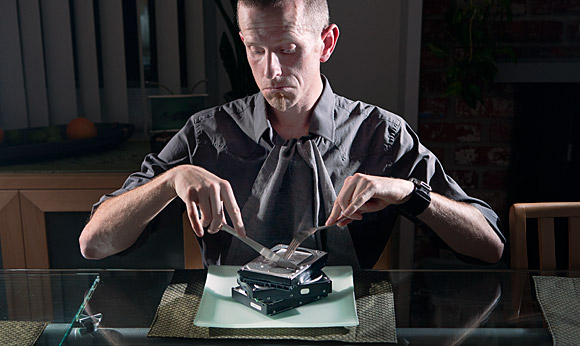
Bits and bytes are mighty tasty. How does one store them for maximum freshness?
Portrait of the Artist as an IT Professional
Artists, designers, composers, mixers, and audio folks of all stripes must be conversant with the tools of their trade, and in this digital world, that means playing some role in managing hardware and software. This is where your hard-won creative output of blood, bits, and tears will be stored…and possibly lost.
This article is meant to help frame the challenge of selecting hard drives for one’s own home studio. I’m no IT professional, but I’ve been dealing with digital multimedia production for nearly 20 years, so I’ve at least got some perspective as a creative professional. I’ve seen my share of hard drives literally catch fire, glitch out, play the national anthem, and just simply stop working, sometimes one a day for three days in a row. I’ve had to manage IT issues from single machines to small clusters to an entire small studio. What follows, then, is what home-studio creatives of all stripes should consider when thinking about storing their creative output on hard drives.
Read the rest of this entry »
Tags: audio equipment, backup, data, hard drive, hardware, home studio, SSD, storage | 3 Comments »
Posted: October 30th, 2010 | Author: Nathan | Filed under: field recording, found sound objects, sound design

Pipes along the side of the road. This is the kind of "a-ha!" or "ooh!" moment recordists wait for!
[Just had to post something orange and slightly eerie. Happy Halloween, all!]
It was a quiet night in a San Francisco warehouse district: Calm wind, not a lot of people on the streets, the sun was going down. A bunch of pipes – probably for redoing water lines beneath the street – were stacked on the sidewalk, perpendicular to the street.
This is precisely the reason that I carry a small, handheld field recorder with me at all times. I shoved it into a few pipes to check out what I could hear. I got some really nice drones with that added pipe/tube resonance and comb filtering, which will definitely go in my growing and rather extensive “unsettling drone” library. Some of the car passbys in the street had a resonant, screaming quality, which may make good spaceship pass-bys as well, or aggressive layers for expressive car ‘bys.
But, I quite liked some of the passages where this drone mixed with the activity of the street. Today’s sound is recorded within a 12″ diameter concrete pipe about six feet long. A lone man walks down the street singing, followed by a bicycle, he continues singing then crosses the street in front of me, a breath of wind really amps up the resonance for a moment, and then a few cars pass by, kicking up loose asphalt. Although it sounds like a mix of street noise with a synth drone underneath it, this is unedited except for some compression and normalization. The imaging is incredibly tight because there was about six feet of 12″ pipe in front of the mic capsules, narrowing the stereo field.
[soundcloud url=”http://api.soundcloud.com/tracks/6555355″ params=”show_comments=true&auto_play=false&color=ee0000″ width=”100%” height=”81″ ]
[Sony PCM-D50 recorder, 90° capsule spread]
Tags: audio equipment, comb filtering, digital audio, field recording, pipe, resonance, singing, sound design, sound effects, tube, urban | 3 Comments »
Posted: July 9th, 2010 | Author: Nathan | Filed under: field recording, gear, nature recording

Lookit that man out there. He's quite a dish.
One of the best reasons to spend a weekend with other sound recordists is a chance to try out new gear. A classic nature recording technique is the use of a microphone set in a parabolic dish.
The general public knows of parabolics mostly from seeing people use them on the sidelines of sporting events. In nature recording, they’re for capturing species-specific sounds rather than ambiences. This is because the microphones in parabolic dishes are mono, and have sound pushed into them by the dish itself. This creates a very narrow “beam” of listening. Perceptually, parabolics seem like they “zoom in” on sounds, but this is simply due to such microphones just attenuating all the sounds outside that narrow cone.
Parabolics are also interesting because the frequency response is directly tied to the size of the dish. For most song birds, this is fine. Besides, making and transporting a 17-meter-wide dish just to get a 20Hz-20kHz frequency response just seems silly. At that point, you’re practically into SETI territory! :-)
I got the chance to use one at the Nature Sounds Society Field Workshop. The unit you see in the photo above was the one used by the founder of the NSS, Paul Matzner, so I was holding a bit of history: Hand-made of fiberglass and aluminum, the NSS archives have lots of photos with Matzner holding this thing. Had I looked at the archives before heading into the field, I’d have gotten a way better handling technique. Holding it by its edges introduced horrendous amounts of handling noise.
Today’s sound is from this unit, recorded at 5:01am at Yuba Pass, off California Route 49. As far as I can tell, this is a chestnut-backed chickadee. You can tell, even in this recording, he’s got a lot of pals around (woodpeckers and sparrows at least).
[soundcloud url=”http://soundcloud.com/noisejockey/chestnut-backed-chickadee-yuba-pass-ca” params=”show_comments=true&auto_play=false&color=dd0000″ width=”100%” height=”81″ ]
[DPA 4006 omni microphone in custom 1m parabolic dish into Sound Devices 702 recorder]
Tags: audio equipment, birds, birdsong, digital audio, field recording, microphone, nature, nature recording, parabolic dish, Sierra Nevada, sound effects | 4 Comments »
Posted: July 3rd, 2010 | Author: Nathan | Filed under: field recording, gear, nature recording
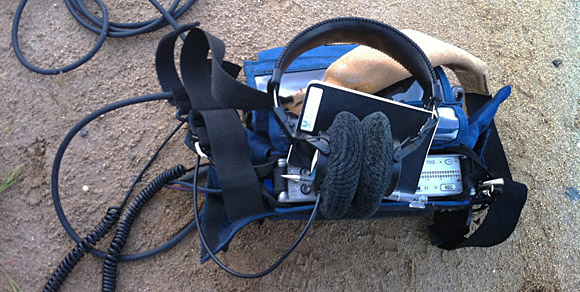
Neither dirt, nor fog, nor clouds of mosquitos keeps a field recordist from his crack-of-dawn tasks!
I’m finally unpacked and rested from the inspiring (and exhausting) 26th Annual Nature Sounds Society Field Workshop in California’s Sierra Nevada. Since my last post was a compilation of high-level personal experiences, I thought that I’d report back about what worked, or didn’t work, in the field on the technology side of things…as well as share a recording from our first early-morning field session.
- Outdoor Gear. My REI trail stool was instrumental in keeping my body still (I can be a fidgety so-and-so), the importance of which can’t be understated when your preamp gain is at 80% of maximum and you can hear birds’ wing flaps 20 meters away. [Hint: For nature recording, more layers of softer materials – like fleece, soft-handed polyester, and wool - are the best for staying warm and silent. Consider gaffer-taping your metal zippers, too!]
- Microphones. My primary MKH 50/30 rig performed brilliantly, with a strong signal-to-noise ratio even in the quietest moments. I also got a chance to try out a rather large parabolic microphone…more on that in a later post. [Hint: If you want a mic for nature recording, you need to be looking in the <-16dBA self-noise range, the lower the better.]
- Recorders. The ol’ 702 worked its usual wonders. I monitored as mid-side in the field, only converting to left/right once I returned. A +8dB side signal using Tom Erbe’s +Matrix plug-in made for a wide, enveloping sense of space without losing center imaging. Â [Hint: Batteries drain faster when cold. Store spares inside your jacket, or in your sleeping bag with you overnight!]
The gear list across everyone was pretty insane: many Olympus LS10 recorders, several Sound Devices 744T’s, a Sony PCM-D50, and mics from DPA, Neumann, Røde, Sennheiser, and Telinga. Recording techniques varied from mono to mid-side stereo, XY stereo, ORTF, Jecklin discs, and even two binaural dummy-head rigs (see this site for a good explanation of all this alphabet soup). An outdoor mic directionality seminar helped to illustrate what each is good for, which was a rare opportunity and extremely educational.
Yeah, yeah, whatever. But what did it sound like?
Today’s sound was recorded around 5:45am on a day with a slight breeze and scads of ground fog. The location was Sierra Valley, north of state route 49 in the Sierra Nevada. This recording includes at least swallows (cave or barn, I’m unsure), American bitterns, red-winged blackbirds, white-faced ibises, yellow-faced blackbirds, and a bullfrog, and certainly more that I can’t identify.
Get those headphones on and close your eyes…
[soundcloud url=”http://soundcloud.com/noisejockey/amb-bird-dawnchorus-sierravalley-01″ params=”show_comments=true&auto_play=false&color=dd0000″ width=”100%” height=”81″ ]
[Sennheiser MKH 50 and MKH 30 recorded as mid-side pair into Sound Devices 702 recorder]
Tags: audio equipment, birds, birdsong, camping, digital audio, field recording, microphone, nature, nature recording, Sierra Nevada, sound design, sound effects | 5 Comments »
Posted: July 1st, 2010 | Author: Nathan | Filed under: field recording, nature recording, news, video/motion
[Sound Design] Field Recording Workshop 2010 from Noise Jockey on Vimeo.
I’m just back from the 26th Annual Nature Sounds Society Field Workshop. I thought that I’d share some video diary entries that I shot with my new iPhone 4. As far as I know, this is the first time that video of this workshop has ever been seen online.
I’ll be sharing more of the learnings, experiences, and recordings in the coming weeks. For now, I hope you enjoy this set of dispatches from the field.
[You can read about the gear I took with me in a previous post.]
Tags: animals, audio equipment, birds, birdsong, digital audio, field recording, microphone, nature, nature recording, nature sounds, Sierra Nevada, sound effects, travel | 8 Comments »
Posted: June 14th, 2010 | Author: Nathan | Filed under: field recording, nature recording, sound design
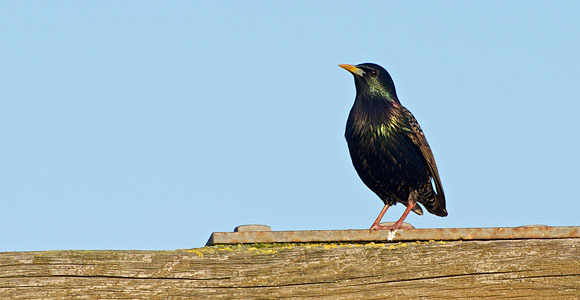
European Starling, hero mutterer and goer-on-forever.
[Photo by donjd2 (CC)]
The European Starling is a common bird that yammers like a manic street preacher. They have a really varied voice, quite expressive for standard birdsong.
I recorded one in my backyard and found that the frequency content really held up well under creative processing (unlike the raspy, high-mid-peaked calls of crows). Today’s sample is a continuous utterance from a starling that’s been pitched down 800 cents and run through the GRM Tools PitchAccum filter, which I just adore for thickening sounds in unusual ways.
For me, it’s evocative of an exotic or alien ecosystem, especially with those other weird R2-D2-like tones in the background…but, again, the vast majority of those tones are being made by a single Starling.
[soundcloud url=”http://soundcloud.com/noisejockey/mutant-starling” params=”show_comments=true&auto_play=false&color=dd0000″ width=”100%” height=”81″ ]
[Sennheiser MKH 50 into Sound Devices 702 recorder]
Tags: audio equipment, birds, birdsong, digital audio, european starling, field recording, sound design, sound effects | No Comments »