No sound designer can resist sound-making objects, so I did some recent damage at ThinkGeek for some small, inexpensive musical items…but then I noticed the robots.
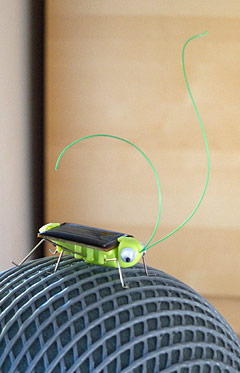
However, I did get a tiny solar-powered grasshopper kit. An offset actuator in its abdomen makes the whole thing vibrate on tiny wire legs when it’s solar-cell carapace is hit with sunlight or a strong halogen source.
Of course, that would sound tiny and delicate. Which is OK. But how to make that sound bigger? Well, you put it on something that will resonate: Something with air around it that will conduct vibrations easily. (I’ve had loud, racous luck with this before.)
Being a hot, sunny Sunday, I chose the top of my closed Weber grill. I tested the sound with contact mics, but the steel was too thick. Truly, and unusually, where my ears were – close to the top of the grill – was where the best sound was. I switched to a hypercardioid mic in a windscreen, and captured today’s sound.
To accentuate the lovely low-mid resonant tones, I applied a huge -24dB cut at 5.5kHz , where the metallic feet where vibrating against the grill (I still wanted a tiny hint of chatter  in there), tand a +9dB boost at 180Hz. Could make for a nice layer with some other design elements.
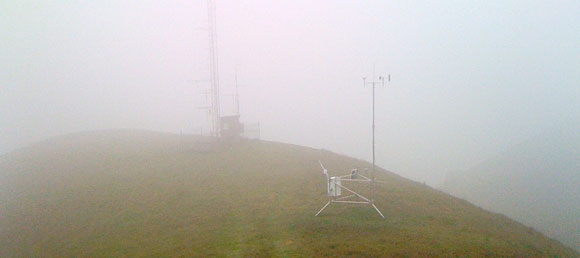
Antennae on Big Rock Ridge, Lucas Valley, Marin County, California. I'm lucky to have found this damn thing in fog like that!
As mentioned in earlierposts, Ben Burtt famously made the Star Wars blaster sounds out of hitting tensioned wires. Who wouldn’t want to do the same? My interest was really in how much or little processing it might have taken to get such an iconic sound, so I had to give it a go.
Well, it turns out that the answer is “precious little.”
Here’s some more audio fun from my recording session in dense fog and high wind with guywires that were stabilizing an antenna array. (I highlighted some wind-in-the-wires drones from this session in a previous post.) This very short collection of samples hasn’t been processed beyond than normalization for loudness. It makes a feller want to go around hitting everything with a wrench!
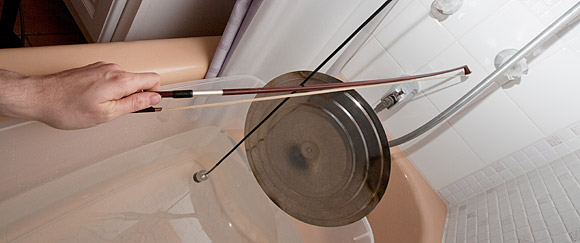
Horse hair, water, mic, and wok lid. Now we're cookin'!
My last post featured teensy finger cymbals being dipped in water while resonating, recorded with a submerged hydrophone. This time we go a bit bigger.
So, I played the wok lid with a violin bow as I moved it into and out of a tub of water, again with the trusty Aquarian H2a-XLR hydrophone tracking to a Sound Devices 702.  The H2a can be overly bright on some material, but for this stuff it was pretty good! (Next time I should record the above-water sound to a second channel with a small condenser mic for more mixing flexibility.)
The recording below is 100% unedited except for some slight compression and normalization.
Dipping struck finger cymbals into water creates some great filtering effects.
[Credit where credit’s due: This is a technique I’ve always wanted to try, and I first heard of it in a great video by Roger Gregg, at around 02:45. The entire series is worth watching.]
So a fellow gets a hydrophone. He’s excited, and starts recording all sorts of crap. But then he has a free hour to himself and realizes that he’s got a box full of sound-making toys and objects that could sound pretty interesting underwater.
Let’s say I’m that fellow.
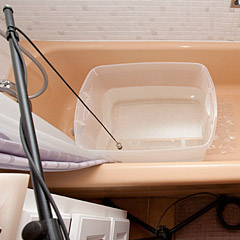
Before work one day, I sifted through said toybox and decided to give this a whirl. In search for a large container to fill with water, I decided to record in the executive washroom of Noise Jockey World Headquarters, and the photos in this post will give you a glimpse of the sumptuous luxury in which we conduct our noisy business.
Since our high-tech executive spa didn’t have a stopper handy, I grabbed a plastic tub and filled it with lukewarm water. I put the hydrophone halfway between the surface of the water and the bottom of the tub, suspended from a boom arm so the cable would be isolated from noise and the mic element wouldn’t sit on the bottom.
An Aquarian H2-XLR hydrophone set into a tub of water.
The Aquarian H2a-XLR hydrophone is pretty heavy and holds quite still. One gotcha is that a high-frequency hiss can occur from air bubbles forming on the microphone casing. This can be a challenge if the water coming out of your spigot is highly aerated. I’m still working on solving that one.
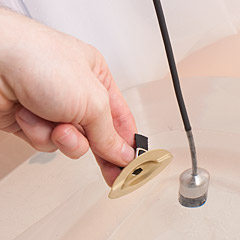
I donned a pair of finger cymbals (truly something every sound recordist should own!) and dipped one or both of them in the water after striking them together. They went into the water at a 60°-90° angle, so that they’d not create entry splashes or secondary water drips. This created a really neat tone that combined a pitch bend with a very resonant filter cutoff.
I’ve attached an edit of the raw recordings to this post. Pitch-bent down or up, obviously, there’s a lot of sonic possibilities for sound design. As with all such experiments I do, I tracked at 192kHz to ensure enough latitude for further sonic malfeasance.
I live near miles and miles of public open space trails, and there’s a ruined hulk of a blue pickup truck a couple of miles from my house. I see it whenever I hike, run, or bike by. It’s been there for years; someone drove it up incredibly steep fire roads and left it.
Some time ago I dragged a field recorder and a windscreen-protected shotgun microphone up those hills and spent an hour milking the rusting chassis for sound. As you can tell by the picture, it doesn’t look like there was much left, but I did get some pretty cool sounds out of it. Like the cigarette machine percussion loop from an earlier post, I’ve assembled the raw sounds into a drum kit. Here’s a quick sample for your  funky, semi-industrial percussion pleasure. No processing other than pitching 2 samples down a bit in the sampler and some compression and EQ in the final mix; it’s rendered as a usable loop, hence the sudden start and stop.
The sound of metal resonating, scraping, straining…doggone it, I just cannot get enough of this stuff.
Doing yardwork one weekend, I noticed my shovel made a great sound as I was scraping soil out of our wheelbarrow. So, naturally, I dragged my wheelbarrow inside our shed, put a large-condenser microphone over it, grabbed the shovel, and pushed its flat blade around the wheelbarrow in various shapes, with and without dirt, for about 20 minutes.
To me, the sounds were evocative of ancient portals, rusted ship doors opening and closing, or the hull of a ship groaning under pressure. What does it make you think of?
This nicotine-dispensing hulk is as playable as a drum kit.
When we moved into our new office, there was this huge cigarette vending machine from the late 60’s or early 70’s left in our foyer. It went from monstrosity to curiosity, and now we’re happy it’s around as an ironic objet d’arte. It went from curosity to obsession once I realized that it could open and its metallic guts could be struck, strummed, and otherwise played like an instrument.
This is one of those sessions I’ll redo someday with better gear, and with sound blankets to dampen the super-bright room (it’s far too heavy to move anywhere else!), but these clips still evoke how expressive this machine is. Here’s a 30-second drum loop made from the raw sounds; the only processing is some EQ and compression.
[soundcloud url=”http://api.soundcloud.com/tracks/5763956″ params=”show_comments=true&auto_play=false&color=ee0000″ width=”100%” height=”81″ ] [Zoom H2, collapsed to mono, made into EXS24 drum kit in Logic Pro]