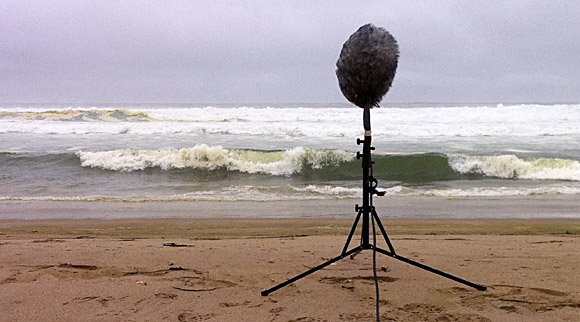
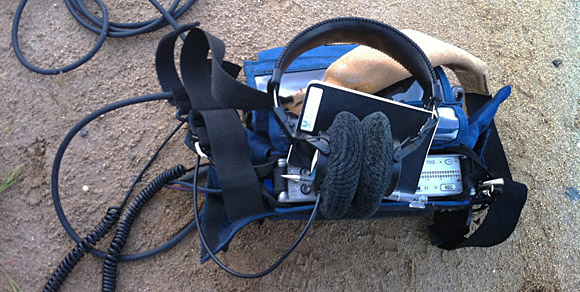
Look carefully: Deep impact zone, short period, wind parallel to the shoreline. Not a good day for recording single waves. So...what is?
It’s easy to get recordings of roaring surf – which can often just sound like constant white noise – but it can be tough to get relatively clean recordings of individual waves. I’ve found that picking a good day and place to record single wave hits are a combination of marine forecasts and location, and that the size of the waves really doesn’t matter.
Single-wave recording conditions are largely defined by a mix of swell, wind, and location.
Swell is due to the large movements of water over great difference; swell is not the same as waves, which are usually wind-driven. Swell is usually forecast based on buoys offshore, and is forecast days in advance. However, I find that 2-day swell forecasts are the most accurate. Swell is defined by wavelength and amplitude, just like audio: Wavelength is is measured in seconds (usually called period), and amplitude (usually called height) is based in feet or meters. Ideally, you want swell with long periods, because that means there’s a greater volume of water moving, but tall swell is also your friend, because that also influences breaking-wave heights at the shore. (Tip: Waves come in “sets” of big and small, between 3 and 8 waves each, depending on if there are multiple wavetrains that are in or out of sync. That means record for far longer than you’d otherwise think in order to get a good range of big vs. small waves over time.)
Getting back to the topic of wind, not all wind is bad (and we all know what wind does to field recordings: huge amounts of badness.) Offshore winds (those that come off of the shore – yes, that is totally confusing!) will might wave faces up longer than they’d be up otherwise, causing a moment of quiet before the wave breaks (or “closes out,” in surf parlance) and a potentially taller wave face. Wind coming onshore (onto the shore from the water) often smears the wave tops and can cause premature toppling…not to mention the fact that the wind will be blowing directly at your microphone capsules. (Tip: You can’t be at the shore without shorebirds, often noisy ones. Bird feeding activity, and therefore noise, may peak before an oncoming storm. Watch the forecast and choose clear weeks with low-pressure days, when it requires more energy to fly, when possible to reduce avian noise. Gulls are complete bastards in this regard!)
Finally, this brings us to location. Some of this is taste: Do you want to record breaking waves against sand, or against rock? Very different sounds will come out of each; bigger crashes will happen on rocks as opposed to sand. But beyond that, know a bit about your location. What direction is the swell and wind coming from, relative to where you’ll be facing? How does the land curve around, creating refraction waves? What is the slant of the land below the shoreline? This last one is especially critical, as the gentler the slope, the bigger the wave. The “impact zone” – where the waves actually break – can be deep or narrow, and a narrower impact zone will generate fewer audible breaking waves at once. Knowing if a beach has a “dumping break” is useful: It makes it terrible to launch from or surf near, but that also means the waves break right at the shoreline, which is far better for audio recording. Just watch out for your gear. (Not a tip, but trivia: Waves always break when the water depth is 1.3x to 1.5x the wave height, as the horizontal energy of the swell gets forced upwards to create breaking-wave heights near shore.)
Never turn your back to the sea. The sea is huge, powerful, indifferent, and above all, unpredictable. Rogue and “sneaker” waves are not legends or myths: They occur regularly, anywhere in the world. Don’t let a recording session end in tragedy.
A final note on technique: If you’re on a beach, angle the mic a bit more downwards than you’d think would be wise, and you’ll get nice sounds of the sand being pulled back as the breaking waves recede back into the ocean. Not always good to have in every recording, but this adds a lot more character. On a beach with fist-sized rocks, this can be especially cool!
I had a recent session at a sandy beach in the Point Reyes National Seashore that exemplified some of the better (but not quite perfect) conditions that I describe above. First, the wind was blowing at 20 knots…but from the opposite direction of the beach I was on, which was backed by hills. That meant delayed wave breaks and being protected from the wind. There was a southerly swell that came right into the dumping-break beach (I can tell the period is averaging 14 seconds by looking at the waveforms of the audio!), so it was all breaking swell and no wind-driven waves. It was a low-pressure day with a long-term clear forecast, and it wasn’t winter, when the masses of migratory birds come through Northern California. Only one swallow’s call made it into the recording.
The recordings aren’t all that dramatic when you consider the breaking waves were only 3-4′ high. But listening to this loud on headphones, eyes closed, I find that the sense of scale is quite exaggerated without an accompanying visual reference…a little Waves LoAir or layering some low-frequency booms can definitely can tip it into cinematically-big breaker territory if desired. However, even in a 90-second clip, there are only three really distinct wave “claps” as the bigger waves close out at the beach.
[One in a series of posts from my spring 2011 trip to the southern California desert.]
Anza Borrego Desert State Park is the second largest state park in the lower 48 United States. It’s dry, as its name implies, but it’s very seismically active and has many natural hot springs and oases scattered throughout the park, so water is less scarce than you’d think.
Even so, it shocked me almost beyond belief how filled some of these hot seeps were with frogs, and how loud they got at night. Sadly, I didn’t get any pictures of these tiny thumb-sized frogs, puffing out their chins to impress their ladyfriends, but I watched them for an hour with my headlamp while I recorded them from several perspectives. (Tip: Get a headlamp with a red LED or filter. This goes a long way in preserving your night vision while still illuminating nearby things like field recorder controls, and tends to spook animals less.)
Here is one long take from this session. It starts with distant frogs, one slow croaker nearby, and then gets really hopping (ugh, sorry, I had to do it) around 1 minute in. Then, after two and a half minutes, it dies down as quickly as it started.
The general public knows of parabolics mostly from seeing people use them on the sidelines of sporting events. In nature recording, they’re for capturing species-specific sounds rather than ambiences. This is because the microphones in parabolic dishes are mono, and have sound pushed into them by the dish itself. This creates a very narrow “beam” of listening. Perceptually, parabolics seem like they “zoom in” on sounds, but this is simply due to such microphones just attenuating all the sounds outside that narrow cone.
Parabolics are also interesting because the frequency response is directly tied to the size of the dish. For most song birds, this is fine. Besides, making and transporting a 17-meter-wide dish just to get a 20Hz-20kHz frequency response just seems silly. At that point, you’re practically into SETI territory! :-)
I got the chance to use one at the Nature Sounds SocietyField Workshop. The unit you see in the photo above was the one used by the founder of the NSS, Paul Matzner, so I was holding a bit of history: Hand-made of fiberglass and aluminum, the NSS archives have lots of photos with Matzner holding this thing. Had I looked at the archives before heading into the field, I’d have gotten a way better handling technique. Holding it by its edges introduced horrendous amounts of handling noise.
Today’s sound is from this unit, recorded at 5:01am at Yuba Pass, off California Route 49. As far as I can tell, this is a chestnut-backed chickadee. You can tell, even in this recording, he’s got a lot of pals around (woodpeckers and sparrows at least).
[soundcloud url=”http://soundcloud.com/noisejockey/chestnut-backed-chickadee-yuba-pass-ca” params=”show_comments=true&auto_play=false&color=dd0000″ width=”100%” height=”81″ ] [DPA 4006 omni microphone in custom 1m parabolic dish into Sound Devices 702 recorder]
Neither dirt, nor fog, nor clouds of mosquitos keeps a field recordist from his crack-of-dawn tasks!
I’m finally unpacked and rested from the inspiring (and exhausting) 26th Annual Nature Sounds SocietyField Workshop in California’s Sierra Nevada. Since my last post was a compilation of high-level personal experiences, I thought that I’d report back about what worked, or didn’t work, in the field on the technology side of things…as well as share a recording from our first early-morning field session.
Outdoor Gear. My REI trail stool was instrumental in keeping my body still (I can be a fidgety so-and-so), the importance of which can’t be understated when your preamp gain is at 80% of maximum and you can hear birds’ wing flaps 20 meters away. [Hint: For nature recording, more layers of softer materials – like fleece, soft-handed polyester, and wool - are the best for staying warm and silent. Consider gaffer-taping your metal zippers, too!]
Microphones. My primary MKH 50/30 rig performed brilliantly, with a strong signal-to-noise ratio even in the quietest moments. I also got a chance to try out a rather large parabolic microphone…more on that in a later post. [Hint: If you want a mic for nature recording, you need to be looking in the <-16dBA self-noise range, the lower the better.]
Recorders. The ol’ 702 worked its usual wonders. I monitored as mid-side in the field, only converting to left/right once I returned. A +8dB side signal using Tom Erbe’s +Matrix plug-in made for a wide, enveloping sense of space without losing center imaging. Â [Hint: Batteries drain faster when cold. Store spares inside your jacket, or in your sleeping bag with you overnight!]
The gear list across everyone was pretty insane: many Olympus LS10 recorders, several Sound Devices 744T’s, a Sony PCM-D50, and mics from DPA, Neumann, Røde, Sennheiser, and Telinga. Recording techniques varied from mono to mid-side stereo, XY stereo, ORTF, Jecklin discs, and even two binaural dummy-head rigs (see this site for a good explanation of all this alphabet soup). An outdoor mic directionality seminar helped to illustrate what each is good for, which was a rare opportunity and extremely educational.
Yeah, yeah, whatever. But what did it sound like?
Today’s sound was recorded around 5:45am on a day with a slight breeze and scads of ground fog. The location was Sierra Valley, north of state route 49 in the Sierra Nevada. This recording includes at least swallows (cave or barn, I’m unsure), American bitterns, red-winged blackbirds, white-faced ibises, yellow-faced blackbirds, and a bullfrog, and certainly more that I can’t identify.
Get those headphones on and close your eyes…
[soundcloud url=”http://soundcloud.com/noisejockey/amb-bird-dawnchorus-sierravalley-01″ params=”show_comments=true&auto_play=false&color=dd0000″ width=”100%” height=”81″ ] [Sennheiser MKH 50 and MKH 30 recorded as mid-side pair into Sound Devices 702 recorder]
I’m just back from the 26th Annual Nature Sounds SocietyField Workshop. I thought that I’d share some video diary entries that I shot with my new iPhone 4. As far as I know, this is the first time that video of this workshop has ever been seen online.
I’ll be sharing more of the learnings, experiences, and recordings in the coming weeks. For now, I hope you enjoy this set of dispatches from the field.
[You can read about the gear I took with me in a previous post.]
Blackstone Canyon, my local refuge from Bad Things.
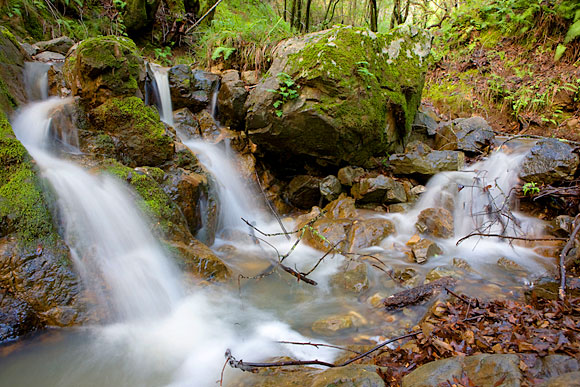
I live at the foot of a number of hills that converge into a canyon not five minutes from my house. We have a very Mediterranean climate, so this canyon is dry in the summer. In the winter, the canyon is alive with creeks, streams, and small waterfalls. These winding watercourses have quite varied voices, from deeply resonant hydraulics to burbling, rock-strewn runs. Its sound never ceases to calm me.
This short piece is an aural tour of my local watershed. It crossfades from one water “tone” to another, from the rivulets at the end of the canyon to some of the waterfalls at its head. Of course, the limitations of MP3 encoding sadly adds some warbling and artifacting to the higher frequencies.
When doing this kind of recording, a medium to long boom pole is essential to get nice up-close perspectives without going into the drink yourself.
[soundcloud url=”http://soundcloud.com/noisejockey/voicesofwater” params=”show_comments=true&auto_play=false&color=dd0000″ width=”100%” height=”81″ ] [Røde NT4 stereo mic into a Sound Devices 702 field recorder]
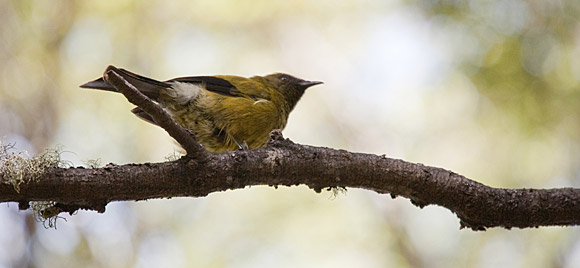
This recording might not be of the bellbird, but what the heck. They produce the most amazing birdsong, so this little green dude deserves this prominent photo position just 'cause!
I recorded some pleasant-enough South Island birdsong one day along the Queen Charlotte Track, and found that there was this amazing, flutelike call deep in the background that went off every 10-20 seconds. It’s pretty far in the distance, but you can still make it out. I’d love to hear any identifications if a reader might recognize this. Â [UPDATE: Reader Barney from Nevada City, California correctly identified this as the call of the Australian Magpie. Thanks, Barney!]
While tiny, Point Lobos State Reserve in of California’s Big Sur region packs a wallop. Big surf, sea lion colonies, petrified dunes, amazing rocks, and a dense forest with many birds. There’s a loop trail that is full of rocky, coastal, dramatic goodness, but there are also little-used paths that cut right across the park. They’re not long and have a utilitarian feel, but one August I was there alone and happened upon a pocket of songbird insanity.
I wasn’t equipped for, or anticipating, an audio recording event, but one must always be prepared! I stood recording for about five minutes and was surrounded by what I think were juncos, sparrows, and warblers (although I’m not a birder, so I could be mistaken – identifications in the comments are encouraged!). I was surrounded by surf but the forest and hills kept the background roaring to a minimum. But the main reason for the clean recording was the volume – the birds stayed in their trees, ignored me, and were just singing their hearts out.
A pretty magical moment, captured as best as I could on the gear I had (some bandpass filtering was used to clean up the recording a bit). Enjoy.
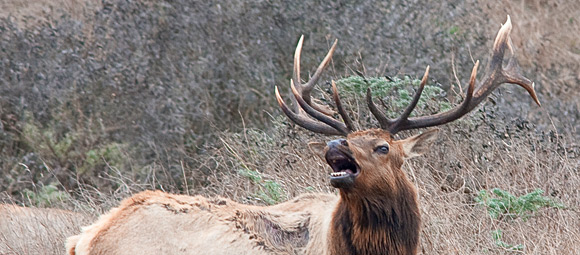
This male Tule Elk was pimpin' with more than a dozen ladies in his harem. But really, who's gonna argue with a burly, mangy, and horny twelve-point bull about his dating habits?Â
The wind and fog were almost enough to dissuade me from visiting the Point Reyes National Seashore to capture images and audio of the California tule elk, one of the largest species of deer in the world. September is the end of the tule elk’s rut, so I was nearing the end of the time-window when I had the best chance of seeing and hearing bulls fighting, courting, and generally carrying on in order to secure mates.
As I drove down the windy, isolated road past long, undulating fences and remote dairy farms, I didn’t find the protected elk herds where I usually see them. I saw and photographed a few stray females, but they don’t typically make any vocalizations. Finally, I saw a harem of sixteen females and one male (“bull”) near the very end of the road. I used my car as a wind break for my microphone and windscreen, settled in, and waited for the stag to vocalize (snapping pictures with my telephoto lens when the opportunities arose). It’s rough to get ambience-free recordings out there; it’s a spit of land surrounded by storm-whipped water on all sides, and the wind was gusting to around 25mph, so the waves and wind were constantly roaring. (Side/tech note: Soundtrack Pro did a far better job on noise reduction, while preserving the desired frequencies and dynamics, than Sound Soap Pro.)
My patience and stillness was ultimately rewarded by several pretty clean recordings of the bull bugling. Trust me, it doesn’t sound like a bugle. More like unholy screams. The male tule elk’s call is as loud as it is piercing, with gigantic 2kHz frequency peaks that are 25dB higher than any other frequency. You may want to turn down your headphones or speakers at first. (I probably should have issued this warning for certain other posts, too.)
Full-Contact Audio: Contact microphones are cheap, fun, and beg for questionable uses.
There are Japanese beetle larvae living in my planter boxes. When we turn the soil, we sometimes unearth over a hundred at a time. We usually dig them out, leave them in a shallow bowl, and the local birds have a feast. I always wondered what disgusting critters that small sounded like, crawling around in a big ol’ pile.
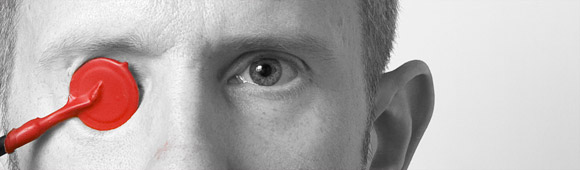
This seemed like a job for contact microphones, the small little piezo elements that detect vibrations through objects rather than through the air. You can make your own for less than $5, but being a complete soldering nimrod, I ordered two hand-built, XLR-equipped and Plasti-Dipped contact microphones from Jeff Thompson at ContactMics.com. I jammed  one of them into this slowly writhing mass. Totally gross. However, the sound was not at all as I had expected: crisp, brittle, and not that slimy. Since I’ve just recontextualized what this sound is, you’ll probably get all creeped out anyway. So enjoy. (Sorry about the ground loop hum, I was in a hurry and didn’t properly troubleshoot…)